Friday, September 21, 2012

Herbert Hoover...and old trucks!

Herbert Hoover's two room boyhood home
Notice the rag rug carpeting
On Saturday, September 15th, we drove to quaint West Branch, Iowa, to visit the Herbert Hoover Presidential Library and Museum as well as his boyhood home, a tiny two-room cottage built by his father and grandfather. Born in 1874 as the middle of three children to a traditional Quaker family, Herbert Hoover spent his early childhood years fishing in the nearby stream and learning the value of education and hard work.

One room schoolhouse
West Branch schoolhouse
His father, Jesse, a blacksmith by trade, opened a farm implement business in 1878, and moved his family to a larger home just down the street. Sadly, in 1880, Jesse died of a heart attack. In keeping with the emphasis on education in the Quaker community, the children’s mother, Hulda, saved money for their education by being thrifty and taking in sewing. As a prominent speaker in the Quaker community, Hulda was frequently called to other Meetings and eventually she caught a cold on one of those trips. In 1884, she died of pneumonia that had developed into typhoid fever, leaving the children orphaned.

Friends' Meetinghouse, West Branch, IA
And although it was a very sad time for the three of them, he remembered that none of the extended family talked about the ‘burden’ of adding more children to their own broods, but rather they fought for the joy of adding the Hoover kids to their homes. 'Bert' lived for a year with an aunt and uncle on a farm in West Branch before he was sent to live with Hulda’s brother, Dr. Henry Minthorn and his family in Oregon.

Herbert Hoover Presidential
Library & Museum
Dr. Minthorn, as superintendent of the Friends Pacific Academy, enrolled young Herbert in the school. Later, in 1888, the family moved to Salem, Oregon, and Herbert worked in his uncle’s Oregon Land Company. In 1891, Herbert attended the first class of Stanford University, graduating in 1895 with a degree in geology.

Exhibit of White House china
He worked in the California gold mines for a few years before taking a position with a British firm that sent him to Australia as a mining engineer. His ability to find a lucrative vein of ore earned him praise, a high salary and the nickname ‘the doctor of sick mines’. By 1900 he earned more per year than even the president of Stanford and became a self-made millionaire by the age of 40. In 1899 he married his college sweetheart, Lou Henry, who also grew up in Iowa, loved the outdoors and graduated with a degree in geology from Stanford.

In 1900 the new couple moved to China to develop coal mines and locate gold. After a wave of anti-Western sentiment spread through the country, the Hoovers survived the Boxer Rebellion, an uprising of Chinese nationalists. Never one to stand by, Lou aided in the nursing of the wounded and helped locate food, medicine and clothing for the injured as well as occasionally (and improbably) standing guard at a barricade before they and other Americans were rescued by the U.S. Marines 10 weeks after the siege began.

Exhibit about Hoover's Belgian relief efforts
Perhaps one of Hoover’s early examples of his Quaker upbringing came at the outbreak of World War I when he left his lucrative career in mining to help stranded Americans return home from Europe. With Belgium torn apart by war, he served as the Chairman of the Commission for the Relief of Belgium. By 1918, Hoover had been appointed as Director General of the American Relief Administration, a position he used to feed over 350 million people in 21 countries. Hoover’s unrelenting pace kicked into overdrive to secure the resources to feed starving citizens across Europe and the Soviet Union.

Ads to promote a
Hoover 'War Garden'
We read about the massive outpouring of thanks from the recipients of Hoover’s aid. After food was delivered in flour sacks, many of the sacks were repurposed into beautiful embroidered items sent back to Hoover. Through the Commission for the Relief of Belgium 20,000 Belgian lace workers were put back to work. With its 600 years of history, the lace industry was in danger of failing during the heavy bombing of Belgium. But Lou lobbied for Americans and British to buy the lace to support the industry and aid the Belgians. On the homefront, Hoover encouraged Americans to grow a ‘War Garden’ to help feed themselves and aid the war effort.

Hoover's many Commerce Dept. projects
Under both Presidents Harding and Coolidge, Hoover served as the Secretary of Commerce, considered at the time a 'backwater' position. But Hoover, in his characteristic style, worked 16 hour days in the role, and in the process created divisions to deal with housing, radio and aeronautics. His Fisheries Bureau helped save Alaskan salmon and he convened a meeting of fishermen and oilmen to protect the Chesapeake Bay. His Commerce Department also sponsored a commission on street and highway safety after more than 20,000 traffic-related deaths the previous year. And Hoover wrote the first federal highway safety code to streamline the sometimes conflicting laws from one jurisdiction to another. He extolled the virtues of standardization within American industry, especially in home building so that average Americans could service their own homes and save money.

The Boulder Dam (now the Hoover Dam) is still considered the largest public works project ever completed, larger even than the Panama Canal, and Hoover was responsible for its construction. In 1921, after 18 days of round-the-clock negotiations between the officials of the affected states, Hoover managed to balance everyone's interests and construction began on the dam in 1931. In 1927, a massive flood of the Mississippi River left over 600,000 people homeless, the largest natural disaster in the country's history. To this, Hoover organized tent cities for the refugees, simply explaining to each township he visited that thousands would soon arrive and they needed everything from sewers and water mains to doctors and meal halls assembled and built within hours. He raised $15M for the Red Cross to help with the relief effort.

With his large-scale humanitarian efforts and tireless work as the Secretary of Commerce, Hoover easily won the presidential election in 1928. But while the country assumed he could do anything and expected nothing less, his administration was soon marred by the Black Tuesday stock market crash in October 1929 that began the Great Depression. Despite an enormous amount of reform and drastic measures to stem the tide of widespread economic blight, his efforts were not enough. (Even as Commerce Secretary he had repeatedly warned of the unchecked speculation in the market and urged reforms and restraint. Unfortunately, his warnings went unheeded by both Harding and Coolidge.)

Elaborate carving of Hoover's life
According to the park brochure, Hoover ‘introduced banking reform legislation, created the Reconstruction Finance Corporation, developed an agricultural credit system, and convened an economic conference to promote trade and stabilize currencies.’ Despite these and other efforts, his second presidential term was not to be. Franklin Delano Roosevelt swept the 1932 presidential election and many of Hoover’s projects became the basis for FDR’s New Deal programs, designed to relieve the economic depression many blamed on Hoover.

For the next 12 years, Hoover was excoriated for the country’s ills until the second World War broke out. President Truman tapped Hoover to help administer food relief to the war torn countries of Europe and the Soviet Union both during and after the war. Lou died in 1944 after sharing her husband’s passion for helping those in need. After being recruited in 1917 by the founder of the Girl Scouts, Lou served continuously as a boardmember or officer in the organization, helping raise funds for development including a kitchen in Washington, DC, where girls could learn to cook.

Hoover's apartment at the
Waldorf Towers in New York
In his later years, Hoover counseled President Truman, and a deep friendship developed despite their political differences. In 1947 Truman asked for his help on re-organizing the executive branch of the government and the Hoover Commission managed to trim out a lot of bloat. His simple one-page reports showed, for instance, an alarming amount of Army surplus (some dating to the Civil War) and no inventory to account for it, among a host of other ridiculous federal expenditures, like the operation of a distillery in the Virgin Islands and a railroad in Panama. Over 70% of the Hoover Commission's recommendations to 'do more with less' were instituted by Truman after his re-election in 1948. Eisenhower, in 1953, again asked Hoover for help trimming the federal government and eliminating waste. As late as 1961 Robert McNamara (JFK's Secretary of Defense) was publicly grateful to Hoover for the billions saved in defense spending. Having restored his former golden boy image and survived the onslaught of blame during FDR's years, Hoover died in 1964 at the age of 90 still working his typical 16 hour workdays.

Graves of the Hoovers
After touring the museum, we strolled past the restored tall prairie land to the couple’s gravesite. In Quaker fashion, the plain tombs bear only their names and dates of birth and death. No plaque or signage denotes Hoover’s legacy as a humanitarian or president, just a simple flag flying over the gravesite.

After walking around the pretty grounds back to the car, we found the Agave Mexican Restaurant for a tasty lunch. We also drove around West Branch and admired the old homes and businesses along the two main streets of the historic section, just beyond the boundaries of the Herbert Hoover park.

Antique gas pumps
After lunch we drove out to the Iowa 80 Trucking Museum, an exhibit of founder Bill Moon’s collection of antique trucks. We began with a trucking documentary by country music legend, Leland Martin. The film showed interviews of a dozen truckers who talked about what they haul, how long they've been driving, why they like trucking and how they manage to have a family in spite of the sometimes long absences. Many of them mentioned the freedom of being on the road with no one to answer to on a regular basis. Sounds like RVing.

Cutest/funniest looking item in the collection
We strolled into the exhibit hall where more than a hundred old trucks of various origins and conditions were displayed. The orange Curtis & Son moving van was our favorite for its color, its silly looking shape and the fact that it was in a movie (The Hours). It was actually made in 1954 by Fageol, a now defunct company.

We also saw a tractor made in 1918 by Avery. This ingenious company used wooden pegs around the wheels instead of tires. The pegs provided traction on farms and could easily be replaced by the owner when they wore out. Smart!

1918 Avery Tractor
The dozens of trucks were each interesting and served, during their lifetimes, completely different purposes. We saw an Army truck that had been converted to a cement mixer by its second owner. A giant post hole digger had been added to the back of another to help a county in Iowa dig holes for telephone poles more than 50 years ago. We even saw a really old U.S.P.S. truck outfitted with skis for use in the snow.

1958 Kenworth 'Bullnose'
In the middle of the showroom, we saw this 1958 Kenworth 'Bullnose' truck, bought by its first owner for $25,000. The design was revolutionary for a couple of reasons. Firstly, the cab over engine design shortened the overall length of the truck, allowing the truck to fit within newly established federal and state length restrictions. Secondly, a mechanic could conceivably work on the engine while standing up, and thus, save labor time. Mr. Moon's Bullnose truck was the very last of its kind built by Kenworth.

The trucking museum was surprisingly interesting and we really liked touring it...the 'Nethercutt Museum' of trucks. Nice. We spent what little remained of our awesome day enjoying the sunshine and listening to the kids in the campground playing and riding their bicycles.

Thursday, September 20, 2012

Is this heaven? No. It's Iowa

Early Winnebago travel trailer
On Thursday morning, September 13th, we watched a family of three deer snacking in the campground as we ate breakfast. Shortly afterward, we packed up and left Pilot Knob State Recreation Area and headed straight for the main attraction in Forest City, Iowa…the Winnebago Factory Tour. Winnebago began producing towable trailers in 1960 and then building motorhomes in 1966. We toured the small museum exhibit in the visitor hall which showcased the company’s beginnings and steady evolution to a leader in the motorhome business.

Fabric choices from
the 70s...yikes
One of the first Winnebago motorhomes
Our tour guide, Jerry, led us on a two hour tour of the company’s factory buildings, beginning with Stichcraft, the soft goods division of Winnebago. Along with all the curtains and pillows for each RV, the Stitchcraft division also produces all the floor mats, bed comforters and cushion covers. Jerry showed us one assembly line where the foam cushions are shrunk temporarily via an ingenious vacuum board that sucks all the air out of the cushion so the cover slides right over it, thus eliminating all the fighting and tugging that would normally take place during such a task. In another area we watched an obviously seasoned seamstress sewing cording onto a king sized comforter. In yet another area Jerry showed us how a laser cutter automatically cuts the cushion pieces out of 25 layers of fabric at the same time. Stacked together, the machine easily cuts through the fabric layers by vacuuming the stack down to the table using a sheet of plastic over everything. Clever!

In the next few buildings we saw various steps in the overall construction of each Winnebago. In one building we saw several workers on a line building the walls of the RVs. They applied the interior paneling to the top of a sandwich including the outside skin, foam insulation, wiring and metal studs before running the whole wall through a roller to squeeze the layers together. Another worker showed us the product of the new machine he was operating: a water saw. The water is used at a tremendous pressure to precisely cut almost anything needed for the RV. While we watched, the machine cut openings through an interior wall piece, all automatically done by computer program. Fascinating! Jerry explained the new machine will replace the numerous old dies formerly used in the process while simultaneously eliminating some of the waste and all of the blade sharpening.

Old Winnebago ad for their
new mirrors
In another area we watched some workers laying the flooring down as the first step in the construction of the interior. Some folks stapled down a vinyl floor while others grouted new tile flooring. Cabinets and door fronts were strung along a conveyor belt in the ceiling leading to the area where they would be installed, programmed by bar code to arrive in a specific order. Other workers were installing televisions in nearly completed Winnebagos, and roofs were being sealed in another area. Outside one chassis after another awaited its turn in the assembly line.

Jerry drove us back to the visitor center and wished us all well, though not before throwing in a pitch for us to replace our Coachmen with a shiny new Winnebago. We'll see. We thoroughly enjoyed the tour and learning about Winnebago's innovations over the years. After leaving Forest City, we headed to Cedar Rapids. We set up camp at the delightful Palisades-Kepler State Park, where we spent the rest of the afternoon enjoying the day and happy hour.

Field of Dreams, Dyersville, IA
On Friday morning we awoke to a beautiful sunshine-y day and after a leisurely start, headed north toward Dyersville. We drove through the rolling corn fields and past tidy little yards in front of old farmhouses along the way. Dyersville is an adorable little town and home to the Field of Dreams, the same field and home used in the filming of the movie by the same title in 1988. After a nice lunch at the Country Junction, we headed out to see the field for ourselves.

Grandstand at the Field of Dreams
The field and house look just like we remem- bered from the movie, released in 1989. We learned that the first tourist was a man from New York driving through the area on his way to California sometime in May of 1989. Since then folks have been visiting from all over the world, sometimes as many as 3,000 people on a busy summer weekend. On our visit, we found it almost empty and only three or four other people there with us.

"If you build it, they will come"
Toe-dipping in the grass
We strolled around the infield and admired the perfect grass in an unseason- ably dry summer. The grass is watered and the field meticulously maintained, all for the enjoyment of visitors like us. Tourists are encouraged to bring a bat, ball and glove to play, because no organized games occur on the field. We took off our shoes and tiptoed in the soft grass. Then we walked into the corn stalks, like the ballplayers from the movie.

A program about the movie and the quirks of shooting in Iowa on a tight Hollywood schedule made for interesting reading. We learned that with the drought in 1988, the corn wasn't growing tall enough for the filming to begin in June, so permission was granted by the county to dam the nearby stream to irrigate the crop. So successful was the irrigation that the corn was then too tall for a scene where the main character walks through the stalks, so the director had Kevin Costner walk on a platform so the corn appeared only shoulder height.

With free admission to the field, a small souvenir stand is the only money-generating operation at the Field of Dreams. We chatted with the friendly clerk briefly before heading back to the campground. What a beautiful day and a perfect field, designed to be a place where busy folks can come to remember what simplicity and the elegant game of baseball mean to them. We headed back to the campground where we settled in for the evening over drinks and then...a roaring campfire complete with toasted marshmallows. Yum! What a serene day.

Thursday, September 13, 2012

Jolly Green Giant SPAM-Burger?

On Tuesday, September 11th, we drove into southern Minnesota. After stopping at a visitor center, we headed straight for Blue Earth and the Jolly Green Giant. Blue Earth is a tiny town whose main industry centers around canning corn and peas for the Green Giant company. With free(!) camping for travelers at the town's fairgrounds, ostensibly to encourage spending at one or more of their numerous antique and gift shops, we took advantage. We opted to hunker down for the evening in the strong wind after a day of battling the steering wheel against it. We did, however, make sure to get some pictures of the Jolly Green Giant, a 60-foot statue just off the highway next to a Dairy Queen. Rumor has it that a related museum can be found downtown, but we arrived too late (and too tired) to visit it. After a nice dinner in the RV, we watched several episodes of Downton Abbey completely alone in the campground area of the fairgrounds. Nice.

In front of the Hormel plant, Austin, Minnesota
In the morning, we headed straight for the...you guessed it...SPAM Museum. About an hour east of Blue Earth is the slightly larger town of Austin, Minnesota, whose entire population must work in one of the numerous buildings operated by the Hormel Company, or at least that's what we figured. We drove past the Hormel plant, the Hormel Medical Research Center and a couple of other Hormel buildings and found the SPAM Museum. Upon entering, we were greeted by a friendly lady who handed us a museum guide shaped like a can of SPAM, complete with 'nutrition facts' on the back side.

S-Pam in a giant SPAM can...
we knew it would come to this.
We entered the museum under a display of 3,500 empty SPAM cans, said to be enough to feed one person every day for more than 10 years. Yikes. That's a lot of SPAM. We were herded into a small theater where we watched a pork-packed showing of  'SPAM: A Love Story', a short film about all things SPAM. We learned of the SPAMettes, a quartet of women without shame or dignity who have adapted several 50s tunes to include Spam, such as "Mr. SPAM-man...Bring Me Some SPAM" and the like. It was hilarious.

A 25 sq ft slice of SPAM Classic
at the center of this sandwich beaut...
enough for 4,800 SPAMburgers!
A SPAM ad from the 30s
Outside the theater, the huge pieces of a gigantic SPAMburger hung from the ceiling next to a 17-1/2 foot spatula stuck to the wall. You can't make this stuff up. Further into the museum, we found everything from puppets mimicking a talk show (introducing important characters to SPAM's past), to a letter from President Eisenhower congratulating the company's 75th anniversary. We learned that obscene amounts of SPAM were sent overseas to feed American soldiers during WWII. Through the Lend-Lease program Soviet soldiers also received SPAM and so did British troops. Wow. (Did too much SPAM start the Cold War after the end of WWII?!?)

S-Pam as a SPAM canner
In another area I tried my hand at canning little pink beanbags of 'SPAM' in a time trial against the factory's output. In the time it took me to throw 6 pink SPAM beanbags into the cans, put a lid on them, 'cook' them, slip the label sleeve on and slap them into the crate, over 650 cans of SPAM were produced in the factory. According to the museum, some 44,000 cans of SPAM are produced every hour. I just want to know who's eating it in quantities to justify that kind of output. Wowza. Oddly, Hawaii has the highest per capita consumption of SPAM in the U.S. And we saw some odd Korean commercials suggesting SPAM's use in a variety of dishes, not the least alarming of which was SPAM sushi. That's just gross.

George Burns and Gracie Allen
hawking SPAM in the 40s
But how fun and pork-filled! We totally loved the SPAM Museum even if neither of us totally loves SPAM. Or even likes it. Or would even buy it even in the case of a total collapse of the world's food supply as we know it. Maybe. Nonetheless, we had a laugh going to a museum with such a great sense of humor about its meaty self. Ha!

A SPAM plea to American wallets
in the 70s
According to the brochure, the museum is good for us. It contains (and I quote) the following ingredients: SPAM products. History. Water. Nostalgia. Carpet. A Viking. Chairs. Facts. Displays. Old cans. Audio visual exhibits. Shopping carts. A letter from Eisenhower. Interactive kiosks. A conveyor belt. Advertising. A wagon. A tent. A puppet show. Glass. An old refrigerator. A game show. Rope. A light show. Fake pork chops. A map. Statues. A shop. Subliminal pigs in cloud murals. Wooden crates. Air. Truth. Serving size: 16,500 square feet

How could we possibly top the goofiness of a SPAM Museum? Couldn't be done. We spent the rest of the afternoon in the RV giggling about the museum and its silly exhibits. What fun!

The Corn Palace...and Sioux Falls, SD!

The Corn Palace, Mitchell, South Dakota
On Sunday, September 9th, we packed up from Chamberlain and drove further east toward Sioux Falls, South Dakota. Along the way we came to Mitchell, a little town known for its elaborate homage to the area's fertile fields...the Corn Palace. First built in 1892, the building was decorated with all manner and colors of corn and corn parts. Everything from the stalk and silk to the leaves and cobs were used to boldly announce the bounty produced by the region's farmers.

Corn display in the Corn Palace
Continuing the tradition, the facade is redesigned and redecorated each year during the Corn Palace Festival Week, held in the third week of August. The design, covering the front and side of the building, is changed every year, incorporating huge panels in the yearly theme. This year's theme is 'Celebrating Youth Activities', as suggested by a local third-grade girl. In that vein, the murals show a golfer, a gymnast, a singer, a runner, an ice hockey enthusiast and so on, all 'painted' with 13 shades of corn. The city's visitor guide indicates that the panels are constructed using blueprints where the plans call for certain colors of corn in each area of the drawing...a 'large-scale corn-by-number'. Ha!

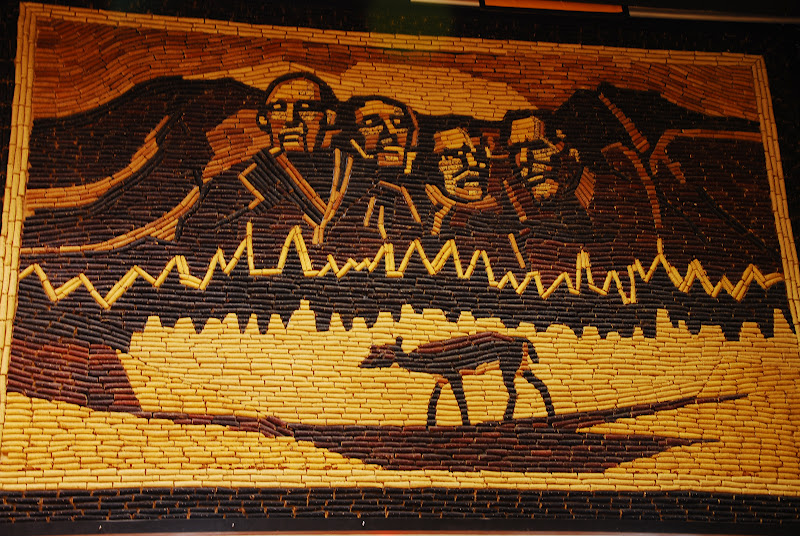
Mount Rushmore...in corn!
We toured the display of pictures of each year's Corn Palace design and admired the drastic changes from one to the next. Even the onion domes on the top of the building are occasionally re-painted. Several display cases are currently exhibiting the corn-themed dinnerware and other assorted corn-themed kitchen items a local woman collected for most of her life. The items are on loan by her family. In the auditorium where concerts, proms, banquets and sporting events are held, we saw a bunch of corn panels around the top of the room with South Dakota themed places, faces and culture.

Corny guys
Across the street from the Corn Palace we found the silly corn guy statue. We posed with him for some pictures while he smiled eagerly through all of them...so friendly!

Falls Park in Sioux Falls, South Dakota
We drove on to Sioux Falls and set up camp at the Big Sioux State Recreation Area, a large park east of the city with only a few other campers. After dinner in the coach, we drove into downtown Sioux Falls to see the city's namesake, a lovely park around the falls of the Big Sioux River. The falls have been central to the town's industry and population, providing hydroelectric power to the Queen Bee Mill, built in 1881, as well as the Sioux Falls Light and Power Company, established in 1908.

View of the falls and the turbine house
from the millrace viewing platform
Near the falls we saw the ruins of the old mill building, formerly a seven story structure constructed of pink quartzite mined on site. Despite its state-of-the-art technology in 1881, the mill closed in 1883 after nearly $500,000 was spent on it and the supporting buildings. The mill race, which provided a channel for water from the river to power the mill via the turbine house, now serves as a viewing platform of the park. The old Sioux Falls Light and Power Company building now houses a cafe and pleasant outdoor seating that overlooks the river below. While reading the placards around the park, we learned of a natural island that once stood in the middle of the Big Sioux River, but whose channels were blocked in 1907 to increase water flow to the hydroelectric plant. Now, the former island is part of the 123 acre Falls Park where we saw scores of local citizens strolling in the evening air.

Old Courthouse Museum
built of local pink quartzite
Courtroom restored to 1900
In the morning, we decided to take in a bit of the culture of Sioux Falls, opting for a whirlwind tour of the city's thrift stores. With our purchases in the trunk, we next headed to the Old Courthouse Museum, occupying the old courthouse, obviously. The museum, built in 1889, offers a little bit of everything Sioux Falls. We saw a piece of a tree whose trunk had been pierced rather dramatically by a piece of a bridge's steel I-beam during a tornado. Yikes. In another area we read all about the Vietnam War and its impact both locally and nationally. It was a fascinating exhibit.

Historic bicycle exhibit
Upstairs, we found an exhibit highlighting the cold of South Dakotan winters, complete with down and fur coats, as well as a beautiful old pot-bellied stove with nickel plating and mica windows. Yikes. It originally cost only $40 for the 'deluxe' model, though we were sure it would today command thousands of dollars. In another room, we toured a display of the history of bicycles, including a Schwinn model similar to one Ken bought (with his own money!) to deliver newspapers as a boy. Cool! We also saw the stunning historic courtroom, restored to its original colors and stencils from 1900. The building was designed by architect Wallace L. Dow, whose Richardsonian-Romanesque style can be seen on many of the buildings he designed throughout Sioux Falls. Another of his famous structures, thankfully still standing, is the T.B. McMartin residence, which we next visited.

Constructed of local pink quartzite in 1889
The McMartin residence, which now houses the Pettigrew Home and Museum, was built in 1889. We trudged the six blocks or so from the Old Courthouse Museum to see this lovely home nestled among a whole neighborhood of interesting houses. South Dakota's first senator, Richard F. Pettigrew, bought the home with his second wife in 1911 for $12,000. With our trusty tour guide, we saw the Pettigrews' home in all its former glory, having been restored to the time period when they lived there. We saw the small galley kitchen, the maid's entrance from her quarters up above, the dining room, the family's parlor, and the guests' parlor all on the main level. The original wall coverings remain intact; a mauve silk damask in the two parlors and a very dark embossed wallpaper (called 'Lincrusta' - a linoleum-like product) on the foyer walls and ceiling. Upstairs our tour guide showed us the Pettigrews' bedrooms and bathroom, as well as a couple of office spaces with only a portion of Mr. Pettigrew's 5,000 volume book collection.

Museum addition to
Pettigrew Home
built of petrified wood
In his last few years, Mr. Pettigrew attached a small museum to the rear of the home, built partly using 4 or 5 boxcars full of petrified wood taken from what would later become the Petrified Forest National Park (and a felony). Adorning the exterior with the petrified wood, he displayed artifacts he had gathered from his extensive world traveling and then bequeathed the collection to the city upon his death in 1926.

Perhaps we should have eaten at Chedd's
...named for The Ched?
We enjoyed the visit to both museums and walked back toward town where we saw the contestants in a local sculpture competition displayed along Phillips Avenue. We attempted to have dinner at a local sushi restaurant, Sushi Masa. In order to sample the sushi before committing to an entire dinner, we ordered a few nigiris and a single roll as an appetizer. No less than 45 hungry (and angry) minutes later, our appetizer finally arrived and, though very tasty, we were reluctant to wait for any more food. Irritated, we left and ate dinner in the RV. Besides being neglected at the sushi restaurant, we had a great day and enjoyed seeing a lot of otherwise charming Sioux Falls.