|
| Wisconsin in the fall |
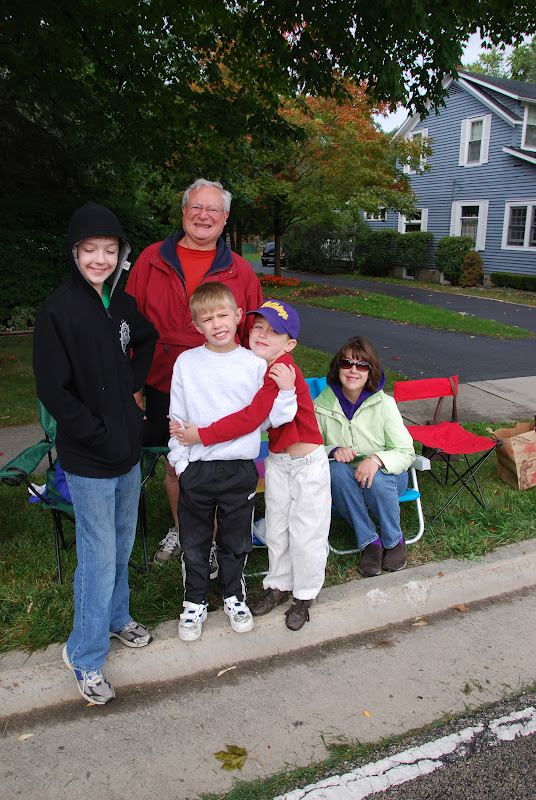
On Tuesday, September 25th, we spent our 8th anniversary driving from Beck and Jon's place in Illinois to an almost completely deserted campground in Cascade, Wisconsin, about an hour's drive north of Milwaukee. After a simple dinner, we spent the rest of the evening planning our next day's activities over happy hour as the sun set just beyond the pretty lake and autumn trees behind us.

On Wednesday, we took in Milwaukee. Part Chicago and part small country town, Milwaukee exudes the charm of a city trying its best to convince visitors it has a lot to offer while simultaneously offering those very things. We began our day with the
Harley-Davidson Factory Tour. Now, neither of us either owns or rides a motorcycle, but we know people who do (a shout out to Monte and Stace here) so the
Harley-Davidson Museum was an obvious addition to our itinerary. We were not disappointed. As we entered, we were greeted by two very knowledgeable and friendly folks who pointed us in the right direction to begin our history lesson in motorcycles.
 |
1903 Serial Number One
Harley Davidson motorcycle |
Upstairs we saw the oldest motorcycle in existence made by William Harley and Arthur Davidson, built in 1903 in a 10 foot by 15 foot shed that would be their factory for the next 3 years. The bike is, not surprisingly, the most treasured in Harley's inventory, but really looks like a simple motorized bicycle. Enchanting in its elegant simplicity, the Number One marked the beginning of what would become a lasting American brand. After expanding their factory space and number of employees, two more Davidson brothers joined the company and in September, 1907, the company was incorporated with stock split between William Harley and the three Davidsons. The foundation of the dealer network, vital to the company's success over the years and through lean times, began in 1917 as well as Harley's temporary production of bicycles. Unlike its competitors who started with bicycles and transitioned to motorcycles, H-D proved it would always go against the grain.
 |
| Sidecar option from 1919 |
As we strolled through the rooms of the First 50 Years, we came across examples of the company's expansion and contraction. Before World War I, the company gained in popularity after repeated racing successes. By 1920,
Harley-Davidson had become the largest motorcycle manufacturer in the world, with over 2,000 dealers in 67 countries. Though the company struggled with low sales numbers during the Great Depression, a jazzy new paint style on its pleasure bikes triggered an increase in sales by 1933. Perhaps more impactful, though, the introduction of the new Servi-car, aimed at businesses, saved the company from the collapse many of its competitors suffered. The Servi-car, purchased by police stations, deliverymen, auto repair shops and others, stymied the loss of business during the Depression and saved Harley-Davidson from insolvency.
 |
| 1932 Police Servi-car |
 |
| U.S. Post Office Servi-car |
H-D also produced bikes for police departments across the country, advertising them as essential to controlling traffic and apprehending suspects. Some even came with a Harley-Davidson chalk stick to mark the tires of parked cars. During World War II, Harley produced motorcycles for the war effort, and essentially stopped all production of private bikes. As one of the very few companies to receive the honor,
Harley-Davidson was awarded the Army-Navy E for excellence in wartime production.
 |
Captain America bike,
similar to the WWII bikes |
When the war ended, many of the servicemen who used or saw Harleys in the field were drawn to them after returning to the States. Harley's post-war production increased to meet the new civilian demand. In 1953,
Harley-Davidson became the last remaining U.S. motorcycle manufacturer after the folding of the Indian Motorcycle Company.
 |
| 1936 El Factory Streamliner OHV V-Twin |
We strolled through the upstairs of the museum, admiring the huge display of Harleys from their first 50 years. As we headed downstairs to see the next 50 years of Harley history, we found the 1936 El Factory Streamliner. Joe Petrali rode this oddly shaped bike in March 1937 and set a new land speed record. Only a few minutes later, perhaps not satisfied with his initial time, he set the world record again, averaging 136.183 mph on the hard sand of Daytona Beach, Florida. After a number of motorcycle racing victories, Petrali went on to help Howard Hughes build the Spruce Goose airplane.
 |
| Some of the early tank designs |
Nearby, we saw a display of the gas tank styles Harley has used over the years. By changing both the tank shape and the paint scheme as well as adding a metal logo, Harley has kept its customers intrigued by its designs. The display of tanks was beautiful and the earliest ones were our favorites. We particularly appreciated the streamlined look of those from the 20s and 30s.

In the adjoining area advertisements from the 50s and 60s hung above bikes produced then. We saw a series of gas tank shaped posters aimed at touting the company's unique design and engine features.
 |
| 'Help Stamp Out Walking' |
Across the way we saw the 60s posters hanging near a snowmobile, scooter and speed boat all produced by
Harley. None of those products lasted very long but the museum plaques assured us they were each in keeping with the innovation Harley has espoused since its early days. In any case, we appreciated the fluorescent red and light blue throwback posters encouraging us to 'Help Stamp Out Walking' with our purchase of a new Harley bike.
 |
| Bedazzled Harley |
We continued into the next section where the custom bikes stood proudly. Each bike looked like a Harley in name only. We also saw easily the gaudiest Harley still in existence. The
1979 Russ and Peg's Rhinestone Harley is bejeweled with glued-on rhinestones in red, white and blue, and built by Russ Townsend. With his never-ending passion for adding more bling, the bike is totally covered in them complete with extra lights in the back to add to the gaudiness. Nice. Nearby we found a comparatively conservative light blue and flames bike custom built and painted by the West Coast Choppers guy, Jesse James.
 |
| Felix Predko's 1941 'King Kong' |
Likewise, we saw a stunning 13 foot long, original condition, tandem bike built between 1949 and 1953 by Felix Predko. Customized over the subsequent 40 years, Predko used two 1941 Harleys while building his '
King Kong'. One fascinating feature of the bike is that Predko custom built an electric starter for it 12 years before Harley-Davidson introduced them on its own motorcycles. Wow.
 |
Pam on the short-lived
Harley 'Topper' scooter |
Before leaving, I tried out the short-lived Harley Davidson Topper. This scooter was produced for only a few years in the 60s, along with the other products designed to increase Harley's reach. Ultimately, despite a buy-out by AMF that lasted for almost 2 decades,
Harley returned to its original, and most successful, endeavor...building motorcycles, where it continues to make waves and inspire new generations of loyal riders.
After our whirlwind tour of the H-D Museum, we tracked down a respectable sushi lunch at Lucky Liu's. And while it doesn't compare to east coast (or west coast) quality, it was tasty and hit the spot. Eager to continue our Milwaukee sight-seeing, we opted next for the obvious: a
Miller Brewing Company Tour.

After the requisite 12 minute commercial for
Miller beer (thinly disguised as a brief company history and a tour introduction video), our tour guide led us toward the South Bottling Plant, one of two such plants on this campus alone.
 |
An original Miller Brewhouse,
built in 1886 |
Here, we watched two different machines wash, sanitize, fill and seal over 1400 bottles and 2000 cans of beer a minute. The precision with which the entire operation works was astounding, and so was the paltry number of employees. I counted maybe 6 line workers in the massive bottling plant. With the machines working so efficiently, precious little nectar of the gods goes to waste. Founded in 1855 by German brewmaster Frederick Miller, Miller Brewing Company has undergone a number of mergers and acquisitions over the last 30 years. Most recently, its parent company formed a joint venture in 2008 with Coors Brewing Company creating the new
MillerCoors.
 |
| Miller High Life...'The Champagne of Beers' |
We moved on to the ridiculously large warehouse where roughly 500,000 cases of beer can be stored until shipped. Our tour guide noted that the beer only sticks around here for a maximum of 36 hours before it's sent out on one of the 300 trucks per day that leave the facility. Yikes. She said that with the warehouse full of beer it would take 22 years to get through the inventory, drinking a six-pack every day. Wow. That's a lot of really mediocre beer. Incidentally, the Milwaukee facility produces over 80 different beers under a variety of labels, but most especially Miller Lite, Miller High Life and MGD 64.
 |
| Fermentation tanks |
 |
| Riverwalk along Milwaukee River |
Despite the assurance that the yeast used in each batch of Miller beer is descended from the original brought to America by the founder in 1855, our samples at the Miller Inn tasted like regular Miller Lite and Miller High Life. Were it not for the third sample, a fruity albeit odd concoction labeled Leinenkugel Lemonberry Shandy, I would have assumed the samples all came from the same keg. Nonetheless, having paid nothing for the tour, we certainly got our money's worth.
 |
| Giant ladybugs! |

We drove off the
Miller- Coors campus and back into downtown Milwaukee. We encountered a sleepy city by anyone's measure, with a fraction of the pedestrian and vehicle traffic expected for a city of this size. Feeling like we had the place to ourselves, we strolled along the
Riverwalk, an outdoor art exhibit of sculptures along the Milwaukee River. With some time to kill before the dinner hour, we wandered through some of the downtown streets as well and came across three giant ladybugs crawling down the face of a nondescript office building. Clearly someone had a sense of humor when decorating this place.
 |
| Whoa |
Nearby, we found the ornately adorned Pabst Theatre and a big clock tower attached to a gorgeous building across the street. But our main interest in this section of town was the Bronze Fonz. Just kidding. But really, we had to take his picture.
Just around the corner, we stumbled upon the perfect location to celebrate our 8th anniversary. Founded in 1966 and cryptically labeled
International Exports Ltd., this place 'imports and exports' at dinner time and is known locally as the '
Safe House'. With almost no signage and only a small door down an alley on the side of a boring office building, we were thrilled we found the place so easily.
Recommended to us by Beck, but without the secret password to avoid embarrassment, we were both made to hop 3 times one direction and then the other, with a shaking of our bunny tails in between, across the small lobby. Thus, we met the stiff entrance requirements as spies and a bookcase opened to reveal a passageway.
The Safe House is a clandestine restaurant offering the right mix of entertaining servers, good food and a host of spy-related memorabilia adorning the walls of the rooms, secret hallways and blind corners.
 |
| International Exports Ltd. (aka 'The Safe House') |
The hostess, after broadcasting our bunny hopping and tail shaking on the restaurant's TV screens, led us to our table. Our cheerful server, Hollie, greeted us as spies and every reference she made thereafter to us, our dinner, our menus, our check, and everything else, had a spy theme to it. She even gave us a list of 'missions' to go on as we awaited our meals. The list offered a variety of cryptic clues about fun stuff to be found in the maze-like rooms of the
Safe House. We saw a piece of the Berlin Wall, a cell door from a German prison, a bronze pig hanging from his tail above the bar, Burt Reynolds naked in the ladies room and a secret passage to the bar next door, the Newsroom. It was a blast.
The dinner was surprisingly good for a place whose reputation was obviously built on its clever theme and word-of-mouth marketing. Trying to blend in with the local spies, we started with a Wisconsin staple: fried cheese curds. They rocked. Yikes. We may have to try to re-create those at home.
Next we each ordered the seafood pasta (very good) and a beer. I had the
Code Beer specially brewed for the Safe House. Not only was it
surprisingly great, but I got to keep the souvenir jar mug in which it was
served. Nice. We loved
The Safe House. Upon ordering a dessert to share, Hollie asked if we needed two 'silencers' to 'take down the subject.' Ha! After scouring the restaurant for clues to the password in case we ever return (we know it now), we headed back to the campground for what little remained of the evening. What an awesome day!
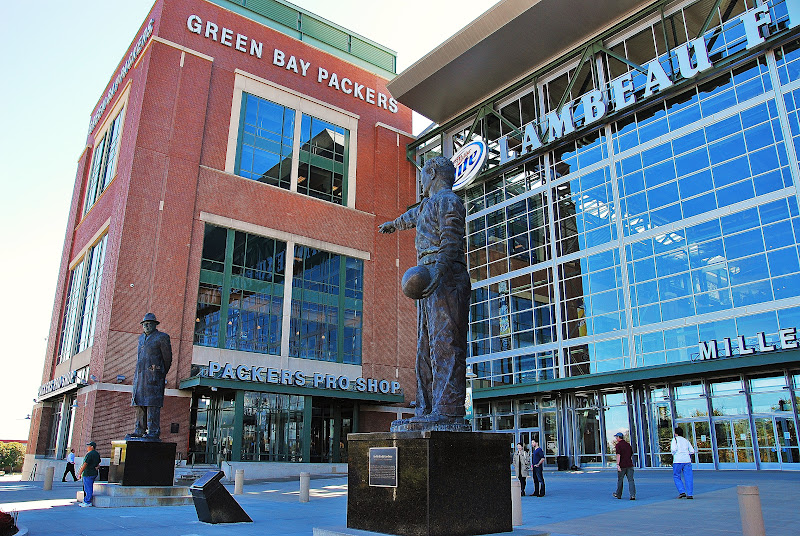 On Thursday, September 27th, we left the campground and drove north. With our trip taking us right through Green Bay, we stopped to see the Packers stadium, Lambeau Field. Since no game was being played in the middle of the day, we had the parking lot almost to ourselves. We walked into the stadium to see about a tour, but apparently the NFL's big ticket reach extends to non-game related events as well. The tickets for a stadium tour were prohibitively expensive, so we opted instead for a free tour of the gift shop.


 We drove into the Upper Peninsula of Michigan shortly after leaving Green Bay and found an autumn colored section of the country whose little towns hint at a slower pursuit of life. We set up camp near the town of Manistique at Indian Lake Travel Resort campground. Nearing the end of the season, we were lucky the campground would still be open for our two nights of camping, though both the water and the trash service were disconnected while we were there. Nonetheless, Indian Lake provided a convenient location from which to launch our tour of the Upper Peninsula, which we began in earnest on Friday, the 28th.


 Our trip back up the path went a bit more slowly than our way down, but we stopped to admire the pretty leaves occasionally and catch our breath. Once back to the car, we continued further east along the shoreline until we came to one of a number of places offering a staple of Michigan's U.P....the pasty. The Bear Trap Inn in remote Van Meer offered one pound pasties and fried Wisconsin cheese curds. How could we possibly pass that up? After indulging in the local delights, we rolled ourselves out of the restaurant. Just outside we saw some folks gathered around the back of truck in which lay a recently shot black bear. Apparently in the U.P. it's legal for some folks to hunt bear, though I understand the meat isn't preferable to many of the others available (like deer, elk or moose). Poor bear.

 Back on the road, we continued eastward and soon came to the Log Slide on Grand Sable Dunes. We trekked out to the Log Slide, a path advertised as a 10 second ride down and more than an hour (or an emergency helicopter ride) back to the top. We gingerly walked out to an edge about a third of the way down from the top, hoping we wouldn't inadvertently trigger a sand slide and end up at the bottom (we didn't). The view of the Lake Superior shoreline from this vantage was long and uninterrupted. So beautiful. At the turn of the century this area was logged of its old growth trees. The log slide itself was a wooden chute (long since disintegrated) down which logs were slid to barges on the lake. According to a sign at the site, two men on a barge were accidentally killed when a log came down the chute and then skipped across the water before crushing them on their boat. Quite a grisly image at such a serene place.