Thursday, April 19, 2012

Las Cruces and White Sands

Duststorm
On Saturday, we left Roswell and Bottomless Lakes State Park for a long and harrowing (for two reasons) drive to Las Cruces, NM.

Number 1: The altitude difference between Roswell and Cloudcroft, NM (roughly halfway through the trip) is about 5000 feet up. Then we descended the same 5000 feet in a shorter amount of mileage before reaching the Tularosa Basin, just outside Alamogordo. Yikes. That was a whole lotta gas going up and a whole lotta braking going down.

Leasburg Dam State Park
Number 2: The weather forecast indicated that we should expect strong winds sustained at 25-35mph, with gusts up to 65 mph. Wow. We hit all of that. The wind was knocking the RV all over the road, it was hard to stay in the lane at times. What we didn't expect (and should have) was the duststorm created by so much wind in such a dry area of the country. As we drove south and reached the Tularosa Basin between Alamogordo and Las Cruces, we saw nothing. The visibility was, at most, about 1/4 mile for portions of the trip and it was the worst in the Basin. We could see only the faintest outline of mountains in the distance. After setting up camp at Leasburg Dam State Park in Las Cruces with the dirt and sand stinging our legs and bare ankles, we spent the evening recovering from the white-knuckle trip.

On Sunday, we awoke to a much calmer wind and a crystal clear view of mountains just beyond the park. Wow, what a sight! And to compare that view with the tan colored sky that blotted out everything the day before, including the skyline and most of the buildings along our route...it was fantastic to see the mountains.

We headed back to the Tularosa Basin to see the White Sands Missile Range Museum and Rocket Park. After passing through security, we walked around the Rocket Park staring at old missiles and guidance systems, as well as the flying saucer the Army claims was the one that crashed in Roswell (though the saucer wasn't launched until 20 years AFTER the Roswell Incident...). In any case, we found the museum closed on Sundays, despite their website and brochures saying otherwise. Too bad, we were really looking forward to the history of the missile program in the area.

Next on our agenda was the White Sands National Monument, a park that protects the extremely unusual geological phenomena of this area.

The two mountain ranges on either side of the Tularosa Basin, the San Andres and Sacramento Mountains, were formed 250 million years ago and then the basin collapsed inward about 70 millions years ago. The Basin does not have any rivers or streams that carry water and sediment away from it, so the snow melt and rain that falls on the mountains around it, flows into Lake Lucero at the lowest point in the basin. The 'lake' then dries up in the desert heat and leaves behind selenite crystals (gypsum sediment in crystalline form) which break apart in the strong winds into gypsum flakes which bounce around until they become sand sized pieces. The smaller the pieces, the whiter they look...thus the white sand dunes.

The dunes are extremely inhospitable places to live for all but a few animals and some plants. We learned about a bunch of them, especially the soapwood yucca, a plant whose every part can be used for something.
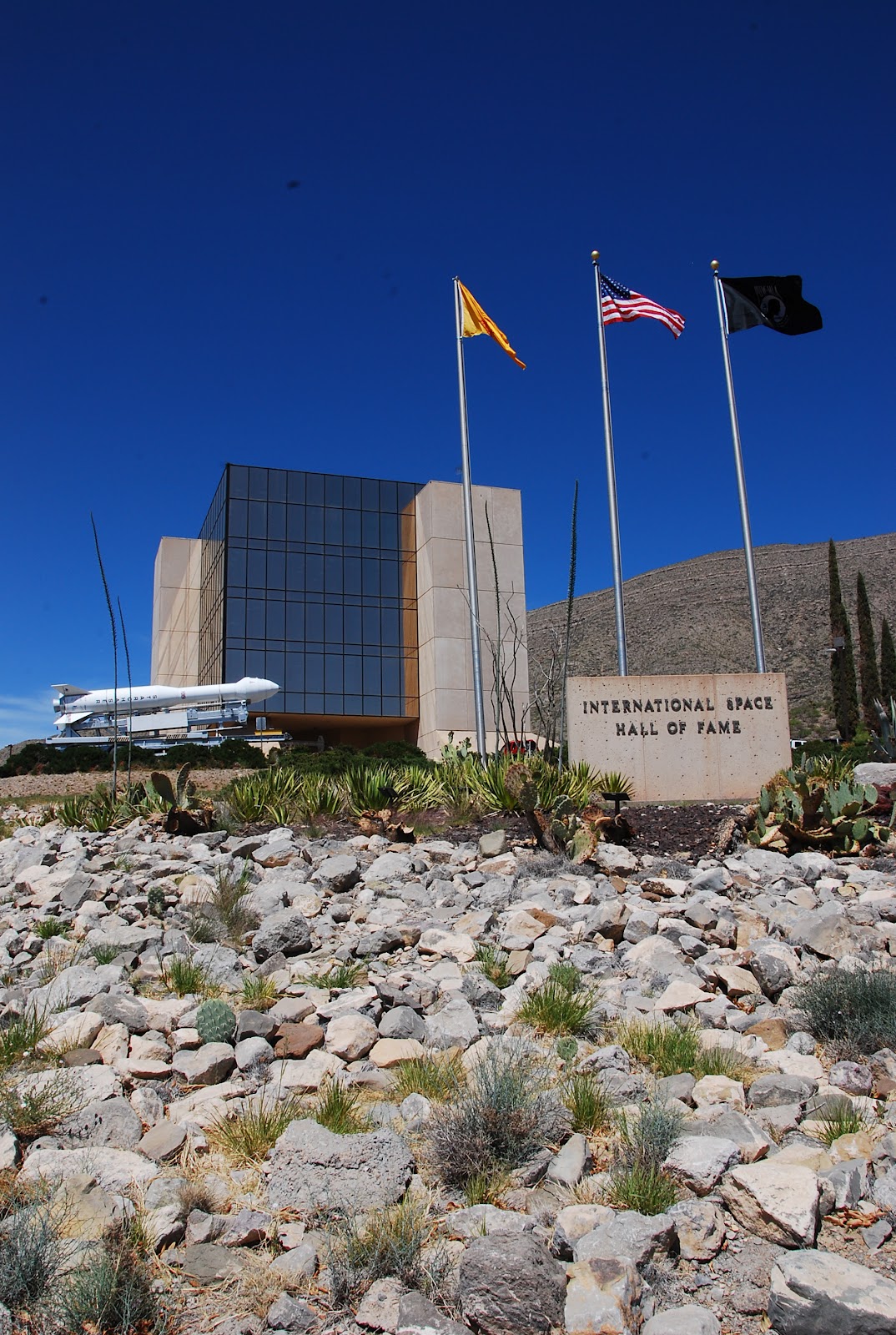
We headed out of the park to visit Alamogordo and the New Mexico Museum of Space History. We drove around the town a little while before venturing up to the museum, where we found a 4-story display of space related stuff and information, along with pictures of all the astronauts inducted into the International Space Hall of Fame. We also watched an IMAX movie, Everest, about a team that climbed to the top of Mount Everest and their struggles in the harsh climate. It was very interesting.

After the museum and movie, we returned to the White Sands National Monument for their sunset stroll and tour with a park ranger. Since we were a couple of hours early for the ranger guided tour, we hiked a part of the trail that leads to the alkali flats and Lake Lucero, where the crystalline form of the gypsum begins its decline into sand. We wandered up and down and all around the dunes and felt like we were walking on the moon. We even saw families sledding down the dunes. It was so much fun!

On the tour, the ranger gave a detailed talk about the native plants and animals in the park and pointed out some of the tracks made by a beetle, a jackrabbit, a sparrow, and even a coyote. After the tour, we watched the sun set behind the San Andres Mountains and the pretty white dunes.

What a busy but great day!

Saturday, April 14, 2012

Carlsbad Caverns National Park, NM

Old Sinclair Gas Station in tiny Greenfield, NM
On Friday, we drove south toward Carlsbad, NM, and along the way we saw this neat old gas station in sad shape. But, hey, it was interesting to look at, so we stopped and took a bunch of pictures. We also found a herd of cows walking on the street, so we rolled down the window and said hello.

We continued on down to Carlsbad Caverns, a network of over 30 miles of caverns up to 1000 feet deep discovered by Native Americans years ago and by other locals at later times after seeing thousands of bats flying out of it at dusk each summer night, as they still do. But the caverns were extensively explored first by Jim White, a fearless teenager who built a rickety ladder to climb down into the giant natural entrance in 1898.

Over subsequent years, he explored the caverns hundreds of times, eventually began taking visitors, and was credited with bringing national attention to this remarkable geological asset. We walked down the Natural Entrance, a 1.25 mile downhill trek on nicely paved switchback trails (installed in the 1950s) until we reached the ‘Big Room’, a huge underground room about the size of 14 football fields.  The caverns have been part of the National Park Service since 1930 and a snack bar and rest area are built into a portion of the Big Room. A set of passenger elevators, originally installed in the 1950s, has eliminated the need to climb back up the 750 foot entrance, allowing access for many more visitors. (Ken remembers visiting the caverns with his parents in the 50s, too!)

We took both of the self-guided tours, the first of the Natural Entrance, and the second of the 1.25 mile tour of the Big Room. Though the room is so large, it is impossible to understand its scale from any one point standing inside it, mostly because it's so dark and there are so many different cave formations all over. We made our way around on the nicely paved, but twisty and hilly path.

The artificial light in the caverns provides only enough light to illuminate some of the formations and allow us to see where we’re going (mostly). And we were told before entering to only whisper to each other because normal speech can travel in the cave up to a ¼ mile away (and many children's, and some adults', voices did just that). The temperature and climate in the caverns doesn’t change, regardless of the weather on the surface. It stays about 56 degrees and 95% humidity all the time. We had a great time!

Back on the top of the planet, I walked around taking pictures of little desert flowers and such. Then we drove back up to Roswell for happy hour again at Pepper’s Grill.

As we were driving to Roswell on Wednesday, we had seen large herds of unidentifiable animals on the ranches, interspersed with the cattle we saw occasionally. At 65 miles an hour we couldn’t tell what we were looking at. The animals (and there were literally hundreds of them in each herd we saw) looked like giant tawny-colored goats or smooth-coated, horned donkeys...we assumed they were a farm animal of some kind. Turns out, they’re pronghorn antelopes! Who knew?? While at the visitor center, the guide there mentioned them and we realized that’s what we’d been seeing all along! So, we went looking for them and only found 8, but, hey, at least we found some.


We headed back to the campground just as the sun was setting over Lea Lake, the lake closest to our RV. We grabbed the camera and watched the sun set over the water…so amazing.

What a spectacular day, both above and below ground!

The Roswell Incident....they're baaaack

On Thursday, we reluctantly left the Santa Fe Skies RV Park (one of the best parks we've been to), and drove through the flat ranchlands of central New Mexico. Our path of over 200 miles led us through some itty, bitty towns, like Ramone (only one abandoned building with a couple of outbuildings nearby) and Mesa (a single abandoned gas station). We also passed through one slightly larger town, Encina, with two gas stations but no grocery store we could see. We wondered where people shop for anything other than beef jerky and Schlitz. Hmmm.

Mulder
Scully
In any case, we arrived in Roswell and set up camp at Bottomless Lakes State Park, a nice campground a loooong way from anything. There are several “bottomless” lakes here which are actually collapsed caves, or sinkholes, that are filled with water. The one closest to the campground is not a particularly large lake by surface area, but is actually 90 feet deep and over 2.5 million gallons of water flow through it everyday. Scuba diving is taught here during the summer and lots of swimmers take advantage of the clear water as well.

We drove back into Roswell, stopping first at the visitor center for a boatload of information about the town and its attractions, as well as stuff to see farther south. The visitor center guide was extremely informative and gave us a bunch of brochures which she tucked into a bag labeled ominously, “Evidence”. Everything in Roswell is alien related. The town’s tagline is: Roswell…Visitors Welcome.  Ha!

We started with the International UFO Museum and Research Center in the middle of town. For a nominal entrance fee and several hours of our time, we read and saw a mountain of evidence about the 1947 Roswell Incident and countless other events, including crop circles, alien abductions, and the historical records of alien landings by numerous civilizations going back hundreds of years. We saw a wall of pictures of flying saucers and the logical explanations of some of those pictures as hubcaps, buttons, hats, and other common items. It was a fun museum and we totally enjoyed reading all about the evidence collected, cover up stories concocted and enduring mysteries surrounding the Roswell Incident, but the written testimony of one after another after another person involved in some way with the initial discovery of the crashed UFO, cleanup of the crash site, transportation of the alien bodies, or anything else related, was really interesting. We’re convinced it actually happened.

After the museum, we stopped at Pepper’s CafĂ© for happy hour drinks and appetizers, and then stayed for a yummy dinner, too. Next, we drove around town taking pictures of aliens in different places here and there. We found one at the KFC, another at the Arby's inviting aliens, another on a cellphone with his spaceship at a hotel, and still another standing on a corner next to a UFO shop. There are little green men advertising loans, selling fireworks, playing a guitar on the side of a Mexican restaurant, and smiling from in front of a furniture store. The town’s ordinary streetlights even have alien eyes painted on them! How silly!

Wednesday, April 11, 2012

The High Road to Taos...the Low Road back...

Creator of holy dirt?
Santuario de Chimayo
On Wednesday, we took the High Road to Taos, a mountainous, twisty, turn-y road through lots of little towns. One such town is Chimayo, a place renowned for its very old Santuario de Chimayo, a sacred Catholic church used as a Good Friday pilgrimage destination each year for over 30,000 of the faithful. The church is also known for its holy dirt, thought by many to cure ailments and afflictions, though, oddly, this special dirt can only be purchased in the gift shop. In any case, we walked around the campus of the tiny chapel and enjoyed the pretty weather and a neighbor horse interested in anyone who would pet him or feed him grass.

San Francisco de Asis Church
Scenery along the High Road
We continued on the scenic high road to Taos, where we stopped at the visitor center for lunch suggestions and tourist options. The friendly guide pointed us down the street to the San Francisco de Asis Church, with the Ranchos Plaza Grille next door. The restaurant was recommended because they have great red chile sauce, fantastic tamales and wonderful sopapillas. We had all three (and other stuff) and totally enjoyed it. After rolling ourselves out the door, we took in the sight of the church under increasingly heavy cloud cover. Just after we dashed into the church to see the altar, the sky opened up and a downpour ensued. We huddled in the church with some German tourists until the rain subsided and then walked around the little plaza to see the other adobe structures around it. We snapped our amateur photos of the church, a building photographed by none other than my favorite photographer, Ansel Adams, and painted by the esteemed Georgia O'Keeffe. Well, la-dee-da.

Rio Grande Gorge Bridge
Rio Grande Gorge
We drove into downtown Taos as the rain threatened to drown us, so we passed on through to see the Rio Grande Gorge Bridge several miles out of town first, hoping for better weather on our return. The Rio Grande flows 800 feet below the unassuming bridge, in the middle of a beautiful landscape in all directions. The mountains off in the distance were cloaked in sheeting rain and thick clouds while the gorge was bathed in sunlight in the foreground...it was gorge-ous!

Kit Carson Home and Museum
We drove back to the historic section of Taos under a fair amount of rain, but once in the town, we were spared a soaking. We walked to the Kit Carson Home and Museum, where we learned about this indomitable man of many talents. He is credited with helping settle vast portions of the western frontier as well as bringing to quick conclusion the war with Mexico. He was a fur trapper, mountain man, and legend in his own time, though his 5' 5" stoop-shouldered, slight frame belied his courage and daring in repelling Indian attacks.

He subsequently served in the US Army during the Civil War and, in 1863, Kit Carson reluctantly agreed to Col. Carleton's orders to round up and force march the Navajos to Bosque Redondo, resulting in thousands of deaths. Many Navajos still consider him to be instrumental in the near-destruction of their people. Later he realized the failure of Bosque Redondo and was influential in Congress' decision to allow the Navajo people to return to their homeland. Shortly after returning from Washington after successfully lobbying Congress, he and his second wife died within a month of one another in 1868 (she of childbirth complications, he of an aneurysm) leaving their 7 children orphaned. Since he was a charter member of the Bent Masonic Lodge in Taos, his home was bought by the Lodge in 1911 and then restored and turned into a museum in the 1940s.

Rain over the mountains
We walked into Taos Plaza, a couple of blocks from the museum, and found a large square surrounded by little shops and art galleries. Taos is known for its strong arts community and we could see it in action all over. Murals are painted in and on various buildings, musicians play in some of the courtyards, and virtually every medium of art is practiced here, from ballooning to weaving to pottery to sculpture and painting.

Scenery along the Low Road
Rio Grande River
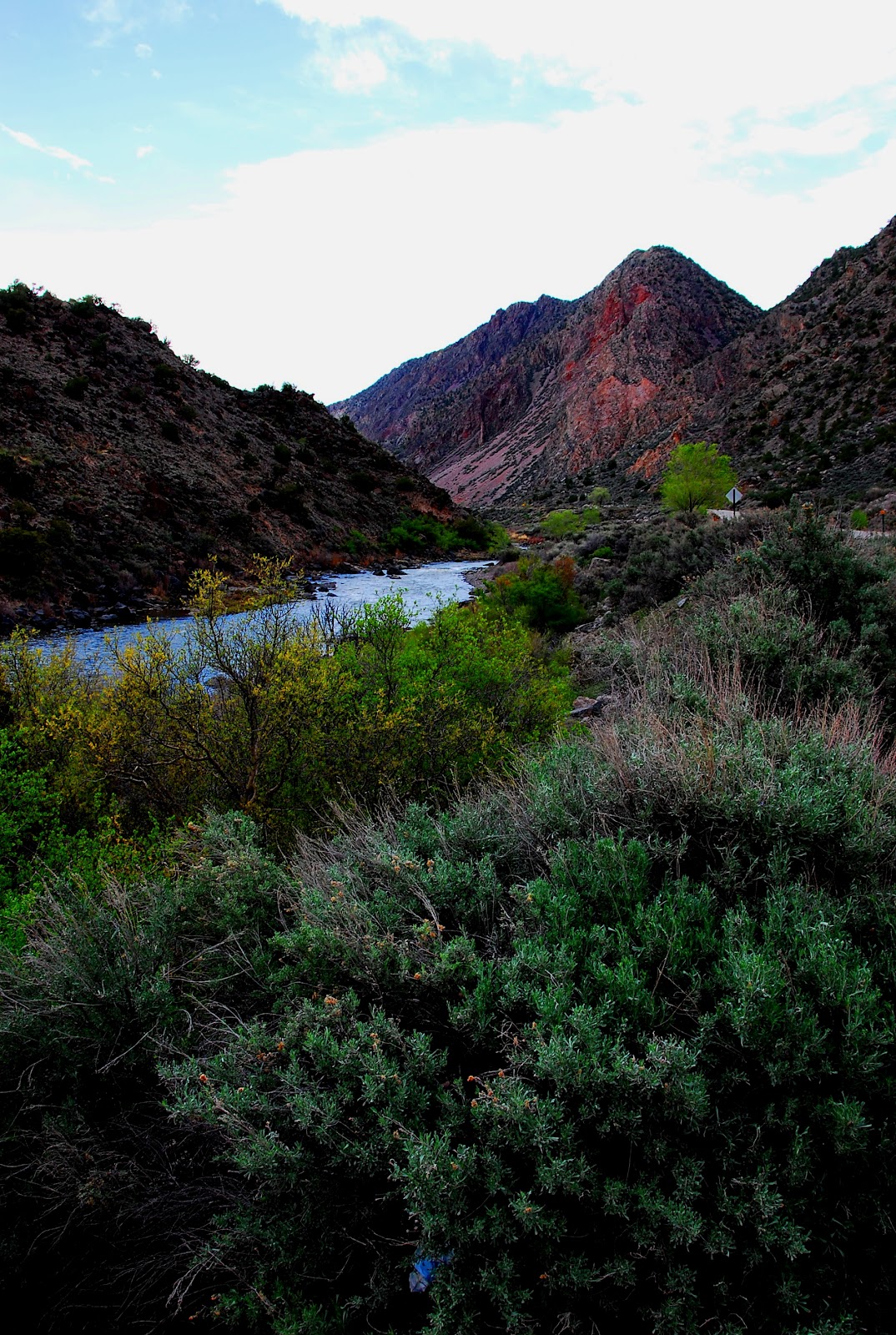
With the clouds looming darkly above us again, we opted for the Low Road back to Santa Fe. The low road simply goes around the mountains instead of through them, but it offers no less spectacular views and, in our opinions, perhaps better ones. We also found the Rio Grande River flowing next to us for most of the return trip, with the snow-capped mountains of Taos in the rearview mirror.

What a pretty day, despite all the rain!

Albuquerque, NM...day 2: Balloons!

First Hot Air Balloons
On Tuesday, we enjoyed a leisurely morning, drinking coffee in the sunshine before heading back to Albuquerque for more sight-seeing. We started with lunch at Jason's Deli, a chain restaurant, but a very, very good one. It has a superb salad bar and excellent veggie sandwiches. Yum.

Up, up and away!
First Gas Balloon
After lunch, we headed over to the Anderson Abruzzo Albuquerque International Balloon Museum. WE LOVE BALLOONS! The Balloon Museum celebrates the city's love affair with hot-air ballooning as well as gas balloons, a whole other species. The exhibits highlighted the history of ballooning, beginning with its introduction near Paris, France in 1783, and on to now with elaborate balloon festivals all over the world. The first passengers on a hot air balloon were a sheep, a rooster and a duck. Having survived the short flight, the cautious King of France then allowed human passengers on balloons, and folks began taking to the skies in them in droves. Women were among the first balloonists and they even began parachuting out of the balloons in aerial shows.

Around the world in eighty days!
Chic-i-Boom
We learned about the firsts in ballooning, too, like first to cross the English channel,  first to cross the Atlantic, first to cross the Pacific, first to circumnavigate the world, longest flight, highest altitude, farthest distance in the shortest time and so on. We read about balloons with different shapes, like the DiGiorno Pizza balloon, Smokey the Bear (just his head!), a Harley Davidson motorcycle, the Space Shuttle, a soda can, the Disney castle and on and on. Upstairs, we found the Carmen Miranda balloon, called the Chic-i-Boom. Ha!

Extra, extra, extra,
extra large pizza, anyone?
We also saw exhibits about the science of ballooning and how the heated air inside the balloon causes it to rise because the air is lighter than the air outside the balloon. We tried our hand at a demonstration of this, with limited success until we got the hang of it. We saw some of the capsules and baskets used to hold the pilot and passengers for a few special balloons, as well.

We enjoyed every bit of the museum, especially when we were trying to pilot a balloon on a simulator. Yikes. Lots of crash landings and tree damage. We never got anywhere close to the target landing spot, but we laughed a lot.

We chatted with the museum store clerk who mentioned (and we totally agree) that nobody ever outgrows balloons. We had so much fun and hope to some day come back for the Albuquerque Balloon Fiesta held every October. Oddly, sharp pins are a huge part of ballooning tradition, with collectable pins given out for every event, competition and adventure. Hmmm. What fun!

Pins for every ballooning event and specialty
Next, we hoped to see the city from the Aerial Tramway on Sandia Mountain, the longest tramway in the world. But, alas, it was closed for routine maintenance for 10 days...perhaps, for the better, though, as two more storms were rolling toward us on the horizon. One seemed to be a rainstorm, similar to yesterday, but the other was obviously a huge duststorm with light brown clouds of dirt blowing all over. It was nasty looking, especially when it blotted out the mountains. Robbed by a one-armed bandit at a casino, we headed back to Santa Fe to wait out the wind, dust and a tiny bit of rain. Ken whipped up a homemade posole soup for dinner (so tasty!!) and we settled in for the evening.

What a fun day!